

1864 . nüchtern . switzerland
1930 . waldau . switzerland

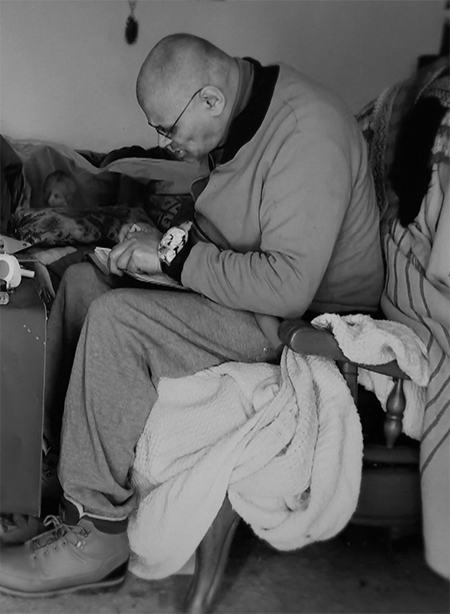
Wölfli’s father, an alcoholic, abandoned him when he was seven years old, and died several years later. His mother died soon thereafter. Young Wölfli found shelter with different farmer families and worked as a shepherd and as a farmhand. At the age of eighteen, he fell in love with a young neighbour. Her parents, however, were opposed to the relationship. Wölfli was devastated. Later, he experienced several other unfulfilled relationships. In 1890, during a walk, he tried to embrace a young girl but was chased away. A similar event occurred the same year, this time with a five-year-old child ; Wölfli was arrested and sentenced to two years in prison. When he was freed, he tried to fit in, but without success. In May 1895, he repeated his offense, this time attempting to abuse a three-year-old girl. He was once again arrested and institutionalized at the Waldau, where he remained for the rest of his life. He was thirty-one when the second part of his life began. His condition worsened during the first five years of hospitalization and he suffered from multiple bouts of hallucinations. Around 1900, he started to draw, to write and to compose music. In 1908, Dr Walter Morgenthaler arrived at the hospital. He became interested in Wölfli as well as in his work and treated him as a full-fledged artist.

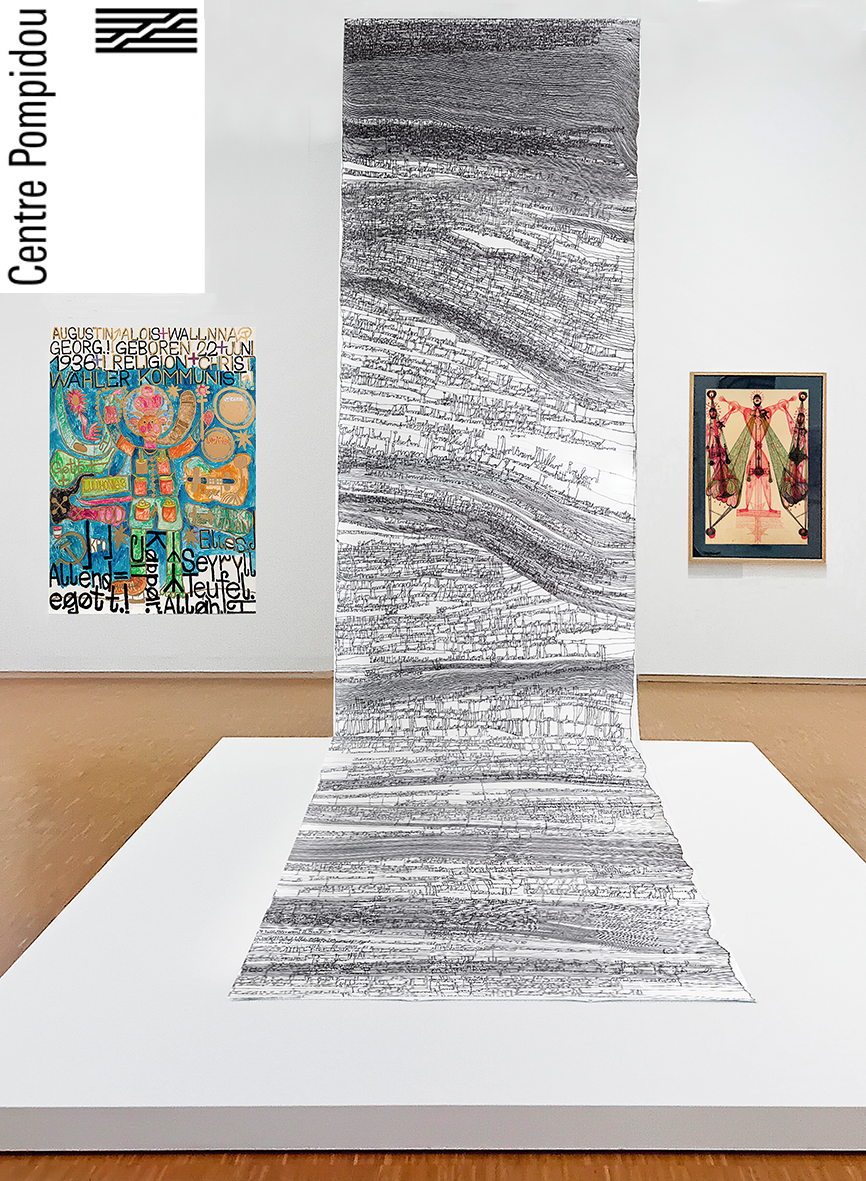
Wölfli’s body of work consists of hundreds of drawings, writings, musical scores and collages. His imaginary biography covers twenty-five thousand pages. He reinvents everything : history, geography, religion, musi. He intends to dominate Creation, Space, Eternity. He plays by juxtaposing opposite perspectives and different points of view, revealing intricate networks, in which ornamental elements have a decorative function as well as a rhythmic one. Wölfli’s musical scores, for example, are as much musical symbols as they are decorative shapes - the notes run like rivers or roads, which in their turn “sing”. Wölfli “rejected”, a victim of a “harsh accident”, because of a “well rhymed but horrible curse” called himself also “Saint” and “Great-Great-God”, “Genius”, “Adolf II”, “Duke”, “Emperor” or simply, “Adolf Wölfli, reformed Catastrophe”. He miraculously escaped “accidents”, “mortal falls” and “attacks by monsters”. If he happened to die, he always revived. But he also called himself “Doufi”, a little sickly man, lost in the scary world, locked up in an endless spiral, lying on his deathbed, in his coffin, in the middle of a labyrinth. In 1928 Adolf Wölfli started composing his Funeral March.


SEE ALSO : 


Publications de la Compagnie de l’Art Brut, fascicule 2. Text by Pr Morgenthaler, translation and prefae by Henri-Pol Bouché. Paris, 1964.


Spoerri, Elka, and Jürgen Glaesemer. Adolf Wölfli, Basel : Rudolf Plüss, 1976.


Spoerri, Elka, Peter Streiff, Kjell Keller, Allen S. Weiss, Michel Thévoz, Jürg Stenzl. Wölfli dessinateur-compositeur. Lausanne : L’Age d’Homme, 1991.


Spoerri, Elka, and Daniel Baumann. Adolf Wölfli, Draftsman, Writer, Poet, Composer. London : Ithaca and Cornell University Press, 1997.


{lang=}